Showing posts with label FAQ Friday. Show all posts

Friday, September 13, 2013

FAQ Friday: Does Granite Have a Completely Smooth Surface?

For the most part the answer is....
Nope.

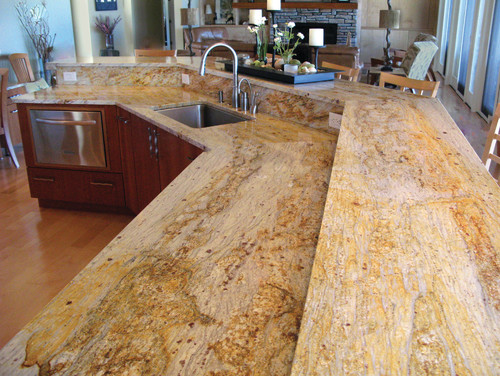
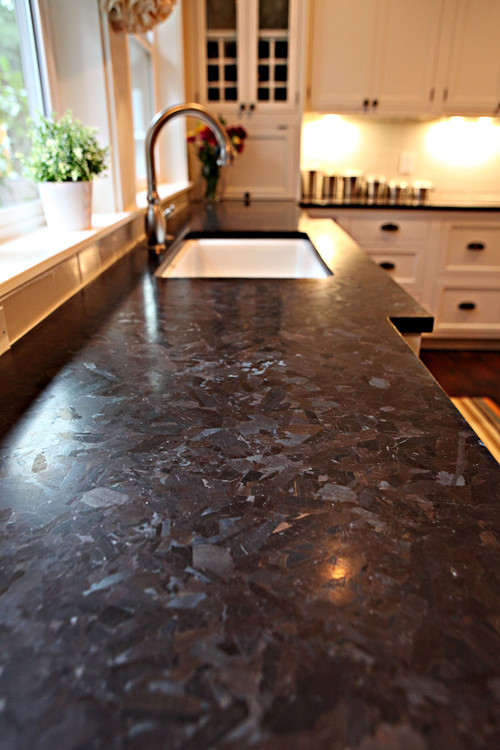
Many granites contain pits and fissures that are natural characteristics of the stone. Some granite colors exhibit these characteristics more than others, and the lighting of the room can make these marks more or less visible.
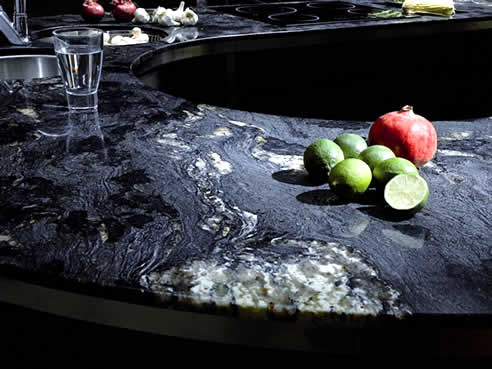
There are a few colors that some customers just can't handle because the veining and surface fissures look like scratches and cracks to them.  The Marron Cohiba (aka Antique Brown) pictured below is one of those colors.

On the other hand Absolute Black granite (pictured below) looks and feels pretty darn close to perfectly smooth.


Friday, September 6, 2013

FAQ Friday: Can I Use Marble on My Fireplace?

I received this week's question via email from Linda T. in Oregon.  She is wanting to use marble on her fireplace surround.
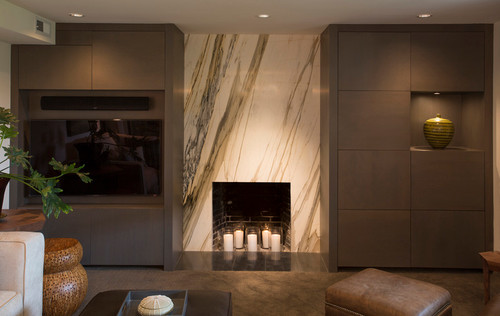
The answer is yes!  Marble is an excellent choice for fireplace surrounds, hearths & mantles.  It's probably the stone you see most often on fireplaces in older homes.
Marble holds up great to the heat of the fireplace. Keep in mind it may etch, but people usually aren't cutting lemons on their fireplace hearths. :)

Friday, August 23, 2013

FAQ Friday: Is Granite a Cost Effective Choice for Outdoor Applications?

Absolutely!
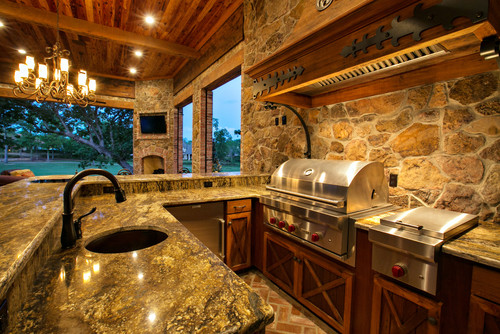
Of course you will pay a bit more for granite than you will for other stone options, or man-made materials.  However, when you think about granite's incredible ability to last forever even if you live in an area with freeze-thaw cycles, it becomes a smart, sensible choice.
Other materials will crumble in high-traffic areas, or deteriorate due to pollution, salt and other urban factors. Granite does not. It combines incredible resistance to wear and tear as well as a natural beauty and charm that other materials simply do no offer.

Friday, August 16, 2013

FAQ Friday: What Are Granite Remnants & When Should I Use Them?

Granite (or marble, limestone, quartz, soapstone, etc) remnants are a great choice for smaller projects.

What are remnants?  They are the pieces left over from other jobs. 
Most granite slabs are between 50-60 square feet.  A typical kitchen uses two slabs.  We have to buy the full slab whether we are using 1/8 of it or 3/4 of it.  More often than not there are usable pieces left over. 
We keep those remnants and sell them for smaller jobs such as vanities, furniture pieces, fireplace surrounds, etc. 
Photo: MGS by Design
 Unless your vanity is rather large or if you have two vanities in one bathroom it is silly to buy a whole slab for a little vanity.  It will save you quite a bit of money to just use one of our remnants.  Sometimes the selection is better than others, but we usually have a lot to choose from.
Photo: MGS by Design
Even this large double vanity above was a remnant from our yard.

Do you live in Utah?  Come check out our remnants at MGS by Design!

Friday, April 5, 2013

FAQ Friday: Can I Install My Own Granite Countertops?

I get this question fairly often and I see it on the internet ALL THE TIME!
I was going to answer this myself, but then I happened upon an older post by Paul Anatar on the Kitchen and Residential Design blog and he answered the question far better than I ever could.
Plus, I think it's one thing for you to hear someone like me tell you not to install your own countertops, I'm making money off of having my company install them. 
When someone not associated with a fabrication shop answers the same way, I think people tend to believe it a little more. 
So, click here to read Paul's response of why you should not install your own quartz (or natural stone) countertops.
Photo by BJ, job is from MGS by Design's portfolio.

Friday, March 29, 2013

FAQ Friday: Can Granite Crack?

We get this question a lot when customer's are considering granite.
The answer...
No, not with ordinary use.
Granite is most susceptible to cracks during shipping and installation.  Once it's installed in your home we rarely have issues with granite cracking.  Sometimes if you have major settling in a new home it will happen, but again, it's rare.
If a crack does start to appear call the fabricator who installed it asap.  There are some things we can do to stop the crack from spreading.  In some cases we are able to repair cracks.
Normal use will not overstress this durable material. That being said, I do not recommend standing on your countertops.  This is not what we consider "normal use". 
SEN Design Kitchen & Bath Professionals eclectic kitchen

Friday, March 15, 2013

FAQ Friday: How to Prevent Fingerprints on Honed Absolute Black Granite

This question comes from a reader of our blog, Jill.
"I want to put honed black absolute counters in my kitchen but am concerned about the fingerprints.  I am happy to wipe the counters often if I have to if there's a cleaner that will do the trick.  Do you have a one to suggest?  Does a color enhancing sealer show less fingerprints?"

I always suggest using a color enhancing sealer when Absolute Black granite is honed.  Mainly because of the coloring, it's goes pretty grey when it's honed.  By using the color enhancing sealer it brings the black back out.
Here's a picture of a piece of Absolute Black that we honed.  The left side does not have any sealer on it, the right side has one coat of Enrich N Seal Color Enhancing Sealer.  
Huge difference in color right?

You can see more pictures of the power of color enhancing sealer here.

The other reason I strongly recommend using color enhancing sealer is for the fingerprints.  When Absolute Black granite is honed every single fingerprint will show and look like a gross, greasy fingerprint if the granite does not have a color enhancing sealer on it.  With the color enhancing sealer you won't have too big of a problem with fingerprints.

I recommend using Rock Doctor Granite Cleaner or Method Granite Cleaner on honed granite.  It's what I use on the honed granite and honed limestone in my own home.  They both do a great job at cleaning up any fingerprints that do occur and do a great job cleaning the countertops in general.  Bonus....I like how they smell.  :) 

For more information about color enhancing sealer go here.
To read more about honing and other surface textures for stones go here.
You can also read my Stone Care & Maintenance Guide here.

Friday, February 15, 2013

FAQ Friday: How Porous Is Granite? The Candle Wax Experiment.

I posted Part 1 of this story, you can read it here.
I got on sort of a tangent that day and didn't finish the post with the great story that I was planning on.
So today for FAQ Friday I'll finish up that question.

A lady I know, we'll call her Anne, was looking at countertops about five or six years ago. She wanted to do granite and ended up doing granite in her kitchen.
While she was looking though, she ran across a solid surface guy, he sells a product that rhymes with morian, so let's call him Mr Morian.  Mr Morian tried really hard to talk Anne out of granite that day.
He told her how porous granite is and that it breeds bacteria and sealing it is a pain...blah, blah, blah, yadda, yadda, yadda.  Mr Morian needs to come up with some new material.
But here's the kicker...he then told her how one time someone left a glass candle burning on their granite countertops overnight. Supposedly during the night the glass broke and the hot wax got all over her granite countertops. He said the granite was so porous that the wax went into the pores of the granite, all the way through the granite and spilled inside of their cupboards and ruined her pots and pans.  Let's get this straight, the wax didn't spill OVER the granite and drip down into the cabinet.  It went THROUGH the granite.  Supposedly.
This is the dumbest story I have ever heard. We had a good laugh over it though and it's been one of my great granite myth stories that I have told over and over. So I guess I have Mr Morian to thank for that.

Well, since I like to be a Myth Buster I decided to bust this myth.
I REALLY tried to give them every single benefit of the doubt in this.

First, I decided to use a granite tile instead of a slab. The tile is 3/8" thick instead of 3/4" or 1 1/4" that slabs generally come in.  So less granite for the wax to go through.
 
In this picture it looks like I'm scared that the wax is going to go through the tile since I put a towel under it.  That's not the case.  I put the towel under it because I was worried that the wax would spill over the sides when I poured it on. 

I chose Juparana St Cecilia granite for this experiment because it's a fairly pourus granite.  It's usually resined, but it's not as dense as the blacks.  Also, I wanted it to be a lighter color so if it stained we would be able to see it.  This piece of tile has NOT been resined or sealed with anything.

I bought a cheap red candle at Wal-Mart.  I thought the cheapness and the redness may help it stain the granite.  I really wanted it to stain!
I let the candle burn all day long so it was nice and hot.  I actually hate burning candles in my house, so this shows you the sacrifices I make in the name of science!  :)
I also warmed up the granite a little.  I didn't want the hot wax to get on the cold granite and have it set right up.  So I thought if the granite tile was warm it would help the wax get into the pores.

Then I left the wax there for over 24 hours. I could tell immediately what the outcome was, but to be fair to the experiment I just left it.
The next day I scraped the wax off with a razor blade and......
it didn't seep through at all! Are you shocked? I sure wasn't.
It actually was incredibly easy to get off. There was a little bit of a moist spot at first. It may have been from the oils or something in the wax, I'm not sure. Nonetheless it dried out and you couldn't see a bit of evidence that the wax was ever there.
I took the picture when the moist spot was still there.
Also ignore the three spot stains, they aren't from the candle. I'll tell you about them another day.

Here is a picture of the back of the tile. Just to show their was no wax through the granite.
FYI, that spot on the right is just sticky from an old sticker we had on the back.
So that's it.  Myth busted.

Friday, February 8, 2013

FAQ Friday: Can I Put Hot Pots & Pans on My Granite?

For some reason the question "Can I put a hot pot on my granite?" is one of the top 5 questions that we always get asked. 
The answer?
Yes you can!
Granite is formed by extreme heat and pressure combined beneath the earths crust. It can not be affected by heat from a cook top or frying pan. A lit flame placed under the granite will have no melting effect and will not leave any burned or scarred marks.
My flat iron has burned the heck out of my laminate countertop in my bathroom, I'm so glad I have granite in my kitchen!

Photo from MGS by Design. Kitchen countertops are Silver Sea Green granite with a 1 5/8" Mitered Edge Detail.

Friday, February 1, 2013

FAQ Friday: How Does Marble & Granite Get Their Names?

I get asked a lot about why stones are named what they are.  Also, it seems like every distributor names their own material.  It is not illegal in the US to rename a stone, so suppliers will often rename their granite or marble to make it seem "exclusive" to them.  Also, names can change due to different languages.  So if you go to 3 different slab suppliers you may just see the same stone three times with three different names.  It's all very confusing and makes my job harder than it needs to be.  :)
Wild West granite. Other names for Wild West include: Wild West Green, Wild River, Fantasy Green, Key West Green and Wild Green.  And there could be a lot of other names out there for this granite as well!

The original names were in Italian.  Usually the name consists of two parts.  The first part describes the color and the second part describes the name from where the stone was quarried. 

Italian Name-----English Definition
Azzuro---Blue
Breccia---Broken Pieces
Dorato/ D'oro---Gold
Fiore---Flower
Giallo---Yello
Negro/Nero---Black
Perla/Perlato---Pearl
Rosa---Pink
Rosso---Red
Verde---Green
Bianco---White

So here are some examples...
Negro Marquina- Is a black limestone from Marquina, Spain.  So the first part Negro is the color (black) and the second part is where the stone was quarried...Marquina!  Make sense?
To make it confusing, here are some other names you will find it called...Black Marquinia, Negro Bilbao, Negro Markina, Negro Bilbao, Nero Marquina, Prete Marquinia, Preto Marquina.

Here's another one...
Bianco Carrara- Is a white marble from Carrara, Italy.

Now, if only suppliers stuck with this equation...or at least called stone the same name things would be a lot less confusing around here!

Friday, January 4, 2013

FAQ Friday: Is Sealing Granite a Pain or Can I Do it Myself?

If you can clean a window then you can seal a countertop.
You can buy stone sealers at any stone supplier, home improvement store or online.
Read the instructions for details, but basically you wipe the sealer on and then wipe it off after a short amount of time.
For more information on sealing and cleaning your granite check out my Stone Care & Maintenance Guide.
Photo: Surfaces Granite
Not too bad right?
Don't let the fact that some stones need to be sealed deter you from having the beautiful countertops that you want!

Friday, December 7, 2012

FAQ Friday: How is Granite Priced?

Most stone suppliers group granite colors from 1-5, "group 1" being the least expensive and "group 5" being most expensive.
Each group represents a price category only. The groups are determined by how available a stone is in the market, somewhat similar to how gemstones are priced.
Don't let the # 1 scare you, it has nothing to do with the quality of the stone.  In fact, sometimes the lower priced granites are the best quality stones.

Below is a picture from our portfolio of a "group 1" granite called Giallo Ornamental.
Photo: MGS by Design
 It does not matter to us what group you choose your stone from, we will fabricate it the same way. However, the group of stone you select will have a direct reflection on your per square foot cost.
Labor is a pretty set cost, it's the granite colors & upgraded edge details that will cause your square foot price to fluctuate.

Below, the Cosmic Black granite is a "group 5".

Note: Please keep in mind prices vary drastically in different areas of the country, per supplier and per fabricator. 
 For example: Giallo Ornamental is a "group 1" granite here in Utah when you buy from us. I've heard in other parts of the country it's as high as a "group 4". Please understand I just talk about pricing that is applicable in our market here in Utah.

Friday, November 30, 2012

FAQ Friday: What is the Difference Between Vein Cut and Cross Cut Travertine?

There are two common ways to cut travertine.  "Vein Cut" and "Cross Cut".  Both are the same stone, they just cut the block differently.
With Vein Cut stone they cut against the bedding so the plane is revealed.  This gives the stone the amazing linear pattern. 
Cross Cut (also called Fleuri Cut) is cut along the bedding plane.  This cut reveals a "flowery", sometimes circular pattern.  Most travertines on the market, especially in tile, are Cross Cut.

Here are some examples of Vein Cut Travertine...
Vein Cut Silver Travertine.  Photo: Counter Culture.
Photo: Alaturca Natural Stones
Photo: Kitchen Clarity
 Below are some pictures of Cross Cut Travertine so you can see the difference.
Photo: Andean Stone Company
Mexican Noce travertine.  Photo: MGS by Design.

Friday, November 16, 2012

FAQ Friday: Is Marble More Expensive Than Granite?

You would think so right?
A lot of people assume marble and limestone are quite a bit more expensive than granite.
That's not necessarily true!
Natural stone has quite a few factors that determine the price.  Origin, availability, and a yield of a given quarry are the main factors.
With both granite and marble there is a broad spectrum of pricing. 
The popular Emperador Dark and Carrara marbles are both similar in pricing to a group 2 priced granite like Giallo Veneziano.
Knap traditional bathroom
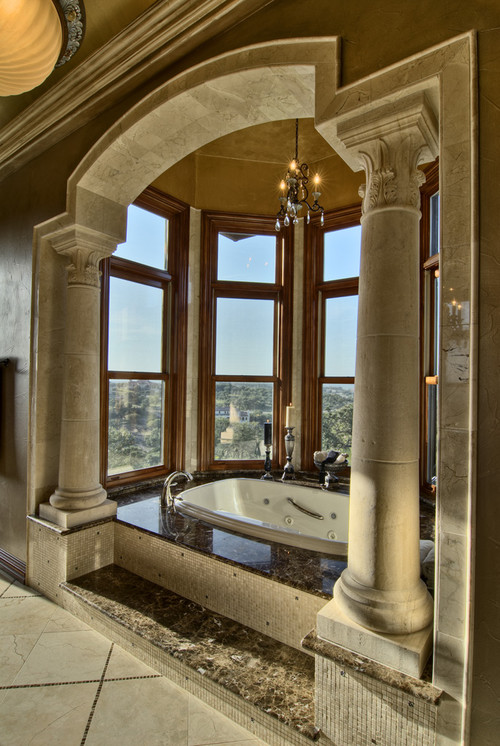
Beautiful Emperador Dark marble on the tub deck in this traditional bathroom design
If you like the look of marble (and are okay with the maintenance) don't disregard it because you think it will be too expensive.  It may just be right in your budget!

Friday, November 2, 2012

FAQ Friday: What is Soapstone?

Soapstone is similar to granite, marble & limestone.  Yet it has some distinct and unique characteristics that put it in a category of it's own.
The name 'Soapstone' is used to describe many different kinds and colors of stone that are primarily made up of Talc. These forms of soapstone are used for carving due to its softness. 
The talc in soapstone feels soft to the touch, it gives the smooth feeling of rubbing a piece of dry soap.  Thus the name.  No, it doesn't lather up and isn't good to wash with.  :)
Soapstone countertops and gorgeous sink.  Designed by Anthony Catalfano Interiors.
The architectural grade of Soapstone (that we use for countertops, etc) is technically called a Steatite.  It's still primarily composed of talc but it also contains other minerals, like magnesite, dolomite and chlorite, which makes it a harder and more dense formation of the stone.
Soapstone is generally 300-400 million years old depending on what country it is quarried from.  It is quarried from all over the world.  The Soapstone we use here in Utah is primarily from Brazil.
The Cristo Redentor in Rio de Janeiro is made of Soapstone & reinforced concrete.
True Soapstone is inert. Alkalis and acids won't affect or etch the surface like they do with the calcium based stones (marble, limestone, travertine).   Many people think of Soapstone as the surface used in science classrooms and labs.  This is due to it being inert and it's longevity.
You will also see Soapstone widely used in wood stoves, fireplace liners, masonry heater fireplaces, pizza ovens, etc.  It has remarkable natural heat retention.  It heats up quickly and then slowly radiates the heat evenly for hours on end, even after the fire has gone out!

Historically Soapstone has been used around the world for tools, vases, sculptures, carafes, goblets, fireplaces, bed warmers, building blocks, urns, grave markers and more.
Currently the most popular ways to use Soapstone are for countertops, sinks, ovens, fireplaces and stoves. 
Photo: House Beautiful
A lot of people think Soapstone is really porous because it's soft to the touch.  This isn't true.  Any stains or discolorations are just off the surface.  This means they can be cleaned, scrubbed and/ or sanded off.  
This includes the mineral oil that you put on it.  If you decide you don't like the darker appearance it can be refinished and the Soapstone will go back to looking like it did in it's natural state.

I highly recommend using mineral oil or beeswax on Soapstone countertops.  This is purely cosmetic.  Soapstone will naturally darken with age.  By using mineral oil or beeswax on Soapstone it brings out the dark, rich colors in the stone.  Treating it initially just speeds up the aging process.  The mineral oil or beeswax will also work as a protective sealing layer to the surface of the stone.
That being said...some people never apply anything to the stone, it does eventually take on it's own natural patina with regular use.  
Photo: Dorado Soapstone
If I were to design my next kitchen today my countertops would be Soapstone.  Hands down.  I love the beauty, simplicity and the natural/living look of it.

If you are considering Soapstone please contact us for a free estimate.  We are also happy to talk through any questions and/or concerns you may have.

Friday, October 26, 2012

FAQ Friday: What's the mesh backing on the back of my slab?

The mesh backing is added at the quarry (or wherever the stone is processed) to add support during shipping and also fabricating the slab.
We are seeing more and more stones have mesh backing lately because of the improved quarrying processes, equipment and technology.  There are a lot of stones that used to be too fragile to quarry, ship and fabricate.  With the improved processes we now have a much larger selection of natural stone to chose from!
Seafoam Green granite kitchen from Bouma Kellerman Design.

All stones are not created equally, some stones are much more difficult to work with than others.  This is just one more reason to keep in mind how important it is to hire a knowledgeable, skilled and experienced fabricator.   At MGS by Design, we often add steel rods to the countertops that we feel may need some added strength, especially at the sink and cooktop cutouts.   Crappy fabricators do not take this extra step and cost.

Thursday, October 18, 2012

FAQ Friday: Will My Granite Look Like the Sample Picture Online?

Yes and no.
The samples you see online are photographs and as such, color tones may differ.
Variations in computer monitors, monitor resolutions and browser displays may also alter the original colors of pictures that are online.
Additionally, consider that granite is a natural material with naturally occurring variations in colour, tone, granularity and pattern. These unique differences are the source of each stone's natural beauty.
Here's an example.
These first two photos are both online samples of Crema Bordeaux from two different websites.


Pretty different from each other right?
Now, here is a picture of a kitchen out of the same color, Crema Bordeaux...
Photo: Paramount Granite
The lesson here is that while you can get an idea of what a stone color looks like online you REALLY NEED TO SELECT YOUR EXACT SLABS.  Stone can just vary so much from bundle to bundle.  Looking at online samples should really just be the first step that helps you narrow down the options.  After that you need to put in the work and spend time at the stone slab yards.

Friday, October 12, 2012

FAQ Friday: A Solid Surface Guy Told Me Granite is Porous, Is This True?

Yes, of course it is.
BUT it is not a problem like they lead you to believe!
All stone is porous, some more than others, but those pores can be sealed.  When they are sealed properly they will not accept other substances.  Keep in mind, that if something can go in, then it also can come out.  Stains can happen, but most of the time they are a result of a granite not being sealed or an individual using the countertop abnormally.
For example: a grape juice spill left overnight on a light stone will most likely stain, but how many of us leave spills on our countertops overnight?  As long as the granite is sealed properly and you remove liquids and foods in a timely manner, then you should be fine.
Oh, and with a little elbow grease you will most likely be able to get that grape juice stain out any way.

There are conflicting opinions about sealing granite.  The Marble Institute of America has this to say...


Marble Institute of America Statement of Position On Sealing Natural Stone Countertops  
Most granite countertops do not need to be sealed. Before 1995 there were very few quality penetrating sealers on the market and there were very few cases of staining. Both prior to and after the availability of penetrating sealers, no cases of food poisoning, radon, or food preparation issues associated with treated or untreated granites have been reported. If a homeowner cleans their countertops after each meal, they will rarely, if ever, have staining or cleanability issues with granite. All this being said, many granite countertops receive additional benefit from being sealed. That benefit is the further reduction of moisture migration into an already moisture resistant surface.

Should natural stone counters be sealed? In many cases it makes sense to seal marble and granite countertops with a quality sealer. The product should have a life expectancy of ten to fifteen years and be of an oliophobic (resistant to water and oil based stains) nature. Once properly sealed, the stone will be more resistant against everyday dirt and spills.

In today’s natural stone industry, many species of granite receive a resin treatment at the factory where the blocks of granite are cut into slabs and then polished. The treatment is used to fill microfissures, indentations and other minor characteristics that are found in many natural stones. The reason for the resin treatment is to address what most consumers consider as imperfections, but in reality are “birth marks”. The consuming public gravitates to perfection, defined as no “birth marks,” and so the marble and granite industry tries to fulfill the desire. Both resined as well as unresined slabs will outlast most of our lifetimes. Granite should, and in most cases will, be the last countertop surface a person will buy, providing a strong return on investment. The bottom line: Sealing resin treated countertops may increase the resistance of the already resistant nature of stone (adopted 11/8/06).

Dimension Stone Design Manual, Version VII, page 3-5, 3-6


Photo: HI Consumption
Now for my opionion...
 I personally agree more with The Marble Institute of America than the conventional thinking of sealing granite countertops once per year. The granite in my house is not sealed and I probably won't ever seal it!  I have even TRIED to stain my granite by leaving oil on it for 16 hours and it didn't do a thing. 
At MGS by Design we seal every countertop that we install (unless you tell us not to).  We do this as an "insurance" policy and to make our clients feel more at ease.

Friday, October 5, 2012

FAQ Friday: What Does 'Bookmatching' Slabs Mean?

"Bookmatched" refers to how the slabs are cut and polished at the factory.
When slabs are bookmatched it means that instead of polishing the same face of each slab, they alternate for them so that they open up like a book.  Thus the name.
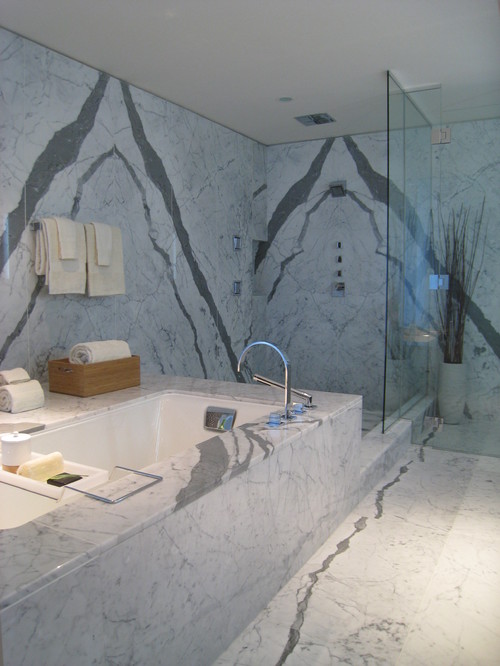
Here's an example of Statuary marble in a bath.  All of the walls are made out of slab.  The seam is where the upside down 'V' is.  See how it opens up and mirrors itself perfectly?

Bookmatching can be expensive, as there is a large amount of waste.
Bookmatched slabs are usually used on feature walls, large islands and slab showers.
When we bookmatch the stone it's always fun to see what the design looks like.  It reminds me of abstract (and sometimes not too abstract) art.  We've seen the silhouette of a woman, animals, faces, hearts, just to name a few things.  


Also keep in mind that not all stone can be bookmatched, it depends on the characteristics of the stone.  It wouldn't make sense to bookmatch Tropic Brown granite.
They are typically stones with strong veins and lines that create very geometric patterns that make your floor, walls or countertops much more interesting. 
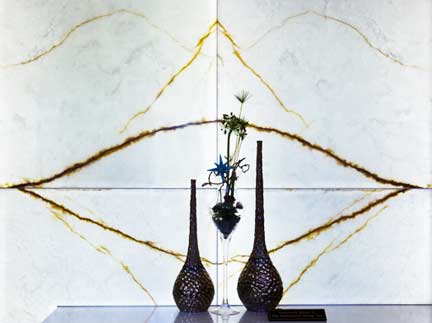
Calacatta Gold (below) really shows it's beauty when bookmatched.

Via
 The factory that cuts and polishes the stone, needs to change the process when the slabs are bookmatched.  Instead of polishing the same face of each slab, they alternate for them to bookmatch. This obviously implies an extra cost for the factory, so it’s really only done with expensive stones that, given their naturally formed veins and lines, look beautiful bookmatched.
If you know you need your slabs to be bookmatched be sure to let your stone supplier know when you are selecting your slabs.  The supplier needs to verify that they give you the correct slabs that bookmatch each other.


Friday, September 28, 2012

FAQ Friday: Is limestone soft and chalky?

Today's question comes from Kathy in New Mexico...
"I love the look of limestone kitchens & baths.  I honestly have only seen limestone in photos, never in real life.  My question is sometimes it looks soft and chalky?  Is it?"

No, it's not soft and chalky at all!  I have Seagrass limestone in my Powder Bath and my Laundry and I actually like how it feels better than my granite. 
There are some limestones that are very hard and dense, nearly as hard and resistant as granite, and extremely non-porous. Keep in mind, though, that these very hard limestone countertops are still calcium-based and anything acidic that gets on them will etch the surface.

Think of using limestone in a kitchen just like using marble.  If you can embrace the etching and let the limestone develop a patina you will love your limestone countertops.  If you want your countertops to look perfect forever consider quartz.  There are quartz colors that have been made to look just like limestone.

Thanks for the question Kathy!  If you have a stone or design question you'd like to see answered here send me an email
Have a great weekend!
Related Posts with Thumbnails